 Lingualite
Why Flashcards Still Beat Every App Feature
Streaks, badges, leaderboards, leagues, animated mascots. The modern language app is a slot machine. The flashcard is boring. The flashcard is also winning.
6 min read
Open the app store and look at the top language-learning apps. Nine of the top ten will be covered in gamification — streaks you must protect at all costs, gems to collect, leagues to climb, owls that emotionally extort you. The flashcard, the oldest and simplest tool in the language learner's kit, is almost nowhere to be found.
The research is unambiguous: the flashcard still beats every one of those features. Here is why.
The thing that actually makes you remember
There is one mechanism in cognitive science that reliably builds long-term memory: active recall. That is the act of retrieving information from your own brain, without cues, without multiple choice options, without hints.
This is different from recognition. Recognition is picking the right answer out of four. Active recall is staring at a blank space and producing the answer yourself. Recognition is easier. Active recall is the one that actually teaches your brain.
A flashcard is the purest possible implementation of active recall. You see the word. You try to remember its meaning. You reveal the answer. You grade yourself. That is it. The whole mechanism is exactly the one your memory rewards.
Why gamified features work against learning
Multiple choice questions, word-matching grids, sentence-tile puzzles — these are recognition, not recall. They feel like learning because they are fun and easy. They are fun and easy precisely because they are recognition. Your brain is barely working.
Streaks create a different problem. They reward showing up, not learning. A five-minute session to protect a 400-day streak, spent clicking through trivially easy reviews, will produce almost no retention. The metric being tracked (consecutive days) has drifted entirely away from the metric that matters (words actually memorized).
None of this is a conspiracy. Gamified features are engagement mechanics borrowed from casino games. They work exactly as intended — they keep users opening the app. They were never designed to maximize learning.
Why the flashcard still wins
The flashcard has no loyalty programme. It will not ask you to build a streak. It will not rank you against strangers. It simply asks: do you know this word, or don't you? If yes, the card goes away for a while. If no, the card comes back soon. Rinse and repeat.
That is a brutal feedback loop. There is nowhere to hide. You cannot fake knowing a word to the flashcard system the way you can to a multiple choice test. The stripped-down honesty is the point.
The other reason: flashcards scale
There is a second, subtler reason flashcards dominate. They are infinitely extensible. You can make a flashcard for any word, any phrase, any grammatical concept, any cultural note. You are not bound to the content a game designer happened to include.
Want to learn the word you saw on a menu in Rome? Make a flashcard. Want to drill a specific verb conjugation? Make a flashcard. The unit of content is tiny and reusable, which is why flashcard decks scale from 50 cards to 50,000 without changing the mechanism.
The catch: flashcards are boring
There is a real reason apps lean on gamification. Flashcards are boring. Review is repetitive. Most learners fail not because the method is wrong but because they quit before the method can pay off.
The answer is not to replace flashcards with games. The answer is to lower the friction around creating and reviewing them. That is where software helps most: making it trivial to generate cards from text you actually care about, queueing them at the right intervals, and getting out of your way during review.
How Lingualite uses flashcards
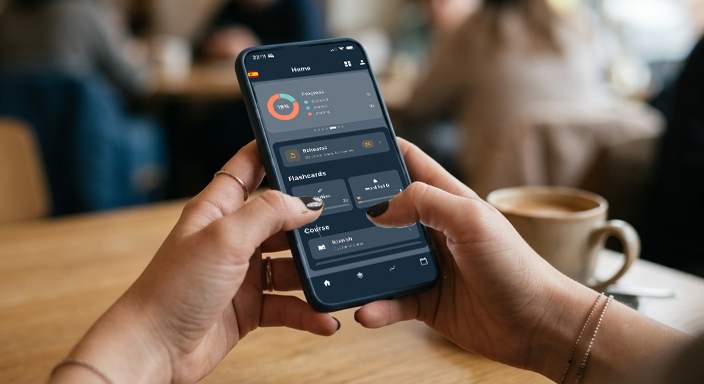
Lingualite keeps the flashcard at the centre of the experience. The AI handles the tedious part — parsing text, extracting vocabulary, building cards with translations and grammar notes. Your job is the one thing no app can do for you: the recall.
No streaks. No leagues. Just cards, review sessions, and a spaced-repetition algorithm that respects your time.
Build your first deck
Paste any text, let the AI do the parsing, and start reviewing. Free to try.